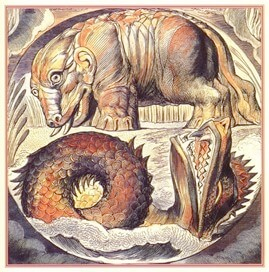
It is this crisis of the idea of progress that we can feel all over Ernst Jünger’s oeuvre, from his famous diaries of his experience in the Great War (In Stahlgewittern), to his “prophetic” work Der Arbeiter and his late novels. But one book of his in particular allows us to penetrate in the nihilistic zeitgeist of the inter-war period: his Auf den Marmorklippen, published at the zenith of Hitler’s power, in 1939. This little book – On the Marble Cliffs, in English –, forgotten in the same way which its author is neglected by the intelligentsia, tells us more about our own times – which are also times of crisis – than several of the “scientific” works that are widespread today, and which denounce a supposedly evident return of fascism. In this jüngerian tale, the despotic figure of the tyrant appears in its most violent essence, as the result of a cosmological disorder that hits society in all of its foundations. On the Marble Cliffs is a book that needs to be remembered, the meaning of which seems today almost as intelligible – and appropriate – as when it was first published.
We aspire to an objective, practical understanding of Ernst Jünger's life and works, and encourage other seekers of freedom and self-realisation to join us. Jünger's insights can function as a valuable roadmap to freedom and meaning for individuals in today's social and spiritual landscape. Crucial is his figure of the autonomous and inwardly-free anarch (in contrast to the impotent and self-destructive anarchist) as presented in his important novel EUMESWIL.
Showing posts with label war. Show all posts
February 17, 2021
Between Order and Disorder: Ernst Jünger on the Marble Cliffs - by Francisco Carmo Garcia
(From VoegelinView, 16 Feb 2021)
January 22, 2020
"In the Trenches of History: the author Ernst Jünger" - 2019 documentary with English subtitles!
Here's a decent documentary film on the German Goethe Prize author Ernst Jünger, produced by rbb/ARTE. i went to considerable trouble to create good English subtitles - hope they'll allow more non-German speakers to learn something of this remarkable thinker.
Source: ARTE.DE (2019)
https://www.arte.tv/de/videos/082773-...
One of the better documentaries on Ernst Jünger, this relatively more balanced production is unfortunately only a partial picture - and not in the sense of being skewed by the usual ignorance level and prejudices - but because it barely covers until 1960, until his move to Wilflingen.
It thus entirely leaves out the critical mature works and themes of Jünger: Eumeswil and the anarch, the Forest Flight (Der Waldgang), The Wall of Time (An der Zeitmauer), Aladdin's Problem, Approaches: Drugs and Inebriation, and much more. In this respect, we optimisticslly view it as Part One, and hope for at least a Part Two to come.
The film presents contrasting views on Jünger from Germanistic professors and other experts. The fairest and most informed contributions come - quite logically - from the two real experts, his recent biographers Heimo Schwilk and Helmuth Kiesel. Some of the other "experts" voice the usual cliched complaints but then almost visibly reluctantly admit his literary greatness. Naturally, it is a simplification of a highly complex person, but perhaps more should not be expected in one hour, given the length and eventfulness of Jünger's life and the complexity of his thought.
One of the better documentaries on Ernst Jünger, this relatively more balanced production is unfortunately only a partial picture - and not in the sense of being skewed by the usual ignorance level and prejudices - but because it barely covers until 1960, until his move to Wilflingen.
It thus entirely leaves out the critical mature works and themes of Jünger: Eumeswil and the anarch, the Forest Flight (Der Waldgang), The Wall of Time (An der Zeitmauer), Aladdin's Problem, Approaches: Drugs and Inebriation, and much more. In this respect, we optimisticslly view it as Part One, and hope for at least a Part Two to come.
The film presents contrasting views on Jünger from Germanistic professors and other experts. The fairest and most informed contributions come - quite logically - from the two real experts, his recent biographers Heimo Schwilk and Helmuth Kiesel. Some of the other "experts" voice the usual cliched complaints but then almost visibly reluctantly admit his literary greatness. Naturally, it is a simplification of a highly complex person, but perhaps more should not be expected in one hour, given the length and eventfulness of Jünger's life and the complexity of his thought.
October 16, 2019
Review of Jünger's WWII diaries in English translation - by Michael Lewis
A Dandy Goes to War
Review of 'A German Officer in Occupied Paris' By Ernst Jünger
Nazi Germany produced two wartime diaries of equal literary and historical significance but written from the most different perspectives conceivable. Victor Klemperer wrote furtively, in daily dread of transport to an extermination camp, a fate he was spared by the firebombing of Dresden. Ernst Jünger, by contrast, had what was once called a “good war.” As a bestselling German author, he drew cushy occupation duty in Paris, where he could hobnob with famous artists and writers, prowl antiquarian bookstores, and forage for the rare beetles he collected. Yet Klemperer and Jünger both found themselves anxiously sifting propaganda and hearsay to learn the truth about distant events on which their lives hung.
One might ask why it has taken 70 years for Jünger’s diary to appear in English translation, for there is no more detailed account of the occupation from the German point of view. But Jünger was always controversial, up to his death in 1998 at the age of 102. In Germany, polite opinion has never forgiven him for Storm of Steel, his memoir of World War I that saw in the experience of combat an ultimate test of manhood. “The finest, most visceral account of battle since the Iliad,” according to the New Statesman, his book made him a hero among German nationalists and ensured his privileged status in Nazi Germany. As it happens, Jünger was anything but a Nazi.
Storms of Steel - audio review of 2003 Hofmann translation
A quick and simple yet insightful introduction to Michael Hofmann's 2003 English translation of Storms of Steel, for anyone who hasn't read it. The reviewer also hadn't read anything of Jünger's prior to this review, so he has a pleasantly unbiased and uncomplicated perspective.
February 23, 2017
Programm des Jünger-Symposions 2017 "AUF DEN MARMORKLIPPEN"
Ernst Jüngers „Auf den Marmorklippen“ – eine literarische Auseinandersetzung mit dem NS-Regime. Ernst und Friedrich Jünger Gesellschaft
Kloster Heiligkreuztal, 7. – 9. April 2017
Freitag, 7. April
20.00 Eröffnung des Symposiums, Alexander Pschera und Thomas Bantle
20.15 Hans-Dieter Schäfer, Ernst Jünger und die literarische Moderne im Nationalsozialismus
21.30 Umtrunk
Samstag, 8. April
09.00 Sigfried Lokatis, Ernst Jüngers „Marmorklippen“ und die Hanseatische Verlagsanstalt
10.00 Detlev Schöttker, Wer ist Otho? Zur Rolle Brasiliens in den Marmorklippen
11.00 Kaffeepause
October 6, 2015
STURM by Ernst Jünger now available in English from Telos Press
Sturm by Ernst Jünger
Translated by Alexis P. Walker
With an Introduction by David Pan
Set in 1916 in the days before the Somme offensive, Ernst Jünger's Sturm provides a vivid portrait of the front-line experiences of four German infantry officers and their company. A highly cultivated man and an acute observer of his era, the eponymous Lieutenant Sturm entertains his friends during lulls in the action with readings from his literary sketches. The text's forays into philosophical and social commentary address many of the themes of Jünger's early work, such as the nature of war, death, heroism, the phenomenon of Rausch, and mass society.
Originally published in installments in the Hannoverscher Kurier in 1923, Sturm fell into obscurity until 1960, when it was re-discovered and subsequently re-published by Hans Peter des Coudres, a scholar of Jünger's work.
April 2, 2015
Gli Annali di Eumeswil: Il Coraggio
Gli Annali di Eumeswil è una rivista pubblicata dal Associazione Eumeswil (Firenze), scritti di narrativa e di saggistica con periodicità annuale. Il tema di ogni fascicolo riprende il tema del ciclo di conferenze del Associazione Eumeswil di quel anno.

Adesso è possibile richiedere direttamente dal Associazione Eumeswil il nuovo fascicolo "IL CORAGGIO" (dal ciclo di conferenze 2014 "Il Coraggio").
Anche gli arretrati sono ancora disponibile:
– TEMPO E DESTINO (2012)
– ORIENTE E OCCIDENTE (2011)
– NOSTALGIA DEL PARADISO (2010)
– IL CRIMINE (2004)
– LA MENZOGNA (2003)
– NATURA E CULTURA (2002)
– IL BOSCO (2001)

Adesso è possibile richiedere direttamente dal Associazione Eumeswil il nuovo fascicolo "IL CORAGGIO" (dal ciclo di conferenze 2014 "Il Coraggio").
Anche gli arretrati sono ancora disponibile:
– TEMPO E DESTINO (2012)
– ORIENTE E OCCIDENTE (2011)
– NOSTALGIA DEL PARADISO (2010)
– IL CRIMINE (2004)
– LA MENZOGNA (2003)
– NATURA E CULTURA (2002)
– IL BOSCO (2001)
February 27, 2014
Ernst Jünger and the living memory of World War I
Thanks to Eliah Bures for this excellent article in the Los Angeles Review of Books on the importance and best use of living memories of war in general and World War I in particular: Rest in Peace: World War I and Living Memory. Eliah focuses especially on Ernst Jünger's war diary, the Kriegstagebuch 1914-1918, which appeared in print in 2010.
A short excerpt follows, full text here.
"One of the most revealing before-and-after comparisons has only recently become available. In 2010, Ernst Jünger’s Kriegstagebuch, 1914-1918 appeared in print, some 12 years after its author’s death at the age of 102. This “War Diary,” which records in meticulous detail Jünger’s 44 months on the Western Front, formed the basis for a host of memoirs, of which Storm of Steel is undoubtedly the most famous. First published in 1920, Storm of Steel underwent numerous revisions, evolving throughout that decade into a manifesto of a “new nationalism” that recast Germany’s battlefield defeat as a spiritual victory, the fiery birth of a new and hardened warrior-elite who would redeem the nation. Even in the amended 1961 edition on which the recent English translation is based, Storm of Steel remains an arresting counterpoint to the received wisdom about the war.
What is striking, however, is how this classic statement of the pro-war myth differs from the war Jünger recorded in his diaries. Indeed, the Kriegstagebuch reveals a soldier who, though clearly the narrator in embryo of works like Storm of Steel, was more susceptible to the war’s grim absurdities than hitherto suspected. If the Kriegstagebuch never gives up on the war as a heroic adventure, it also records moments of clear disillusionment. As Jünger wrote in May 1917, in a meditation on the war’s devastated landscape: “When will this shitty war come to an end? What might one have seen and enjoyed during this time… But still no end in sight.”
There is, in fact, hardly a trope, image, or barb familiar to students of the anti-war myth that fails to find its way into the Kriegstagebuch. Jünger resents the orders of staff officers and begrudges ideas about the conduct of the war from those “rear-area pigs” less acquainted than he with conditions in the front lines. The gulf between the truth of actions Jünger has taken part in and the sanitized accounts that appear in official communiqués calls forth responses ranging from bemusement to disgruntled annoyance. Time and again he catalogs the miseries of rain, mud, cold, lice, boredom, shabby quarters, meager rations, interrupted sleep, and sheer exhaustion. And above all there is the ubiquitous presence of corpses: the soft feel of bodies beneath one’s feet; the unmistakable smell of decomposing flesh, particularly unwelcome at mealtime; the sight and sound of maggots; bodies bloated and covered in flies; the discovery of corpses — or, more often, a mélange of their component parts — while digging in; and the relentless effects of artillery, disturbing and dismembering bodies long dead like a plow turning and breaking the soil. (“Not even the dead,” Jünger dryly notes, “are permitted to rest in peace.”) Death, when it comes, strikes randomly and from points unknown. That the liberal consumption of alcohol figures so prominently in Jünger’s diaries is hardly a surprise."
May 6, 2012
Intellectual prejudice - quantified and visualised
"What we do here is to judge a 100 year old man based
only on what he did between his 19th and, let’s say, 29th year, and everything
that he wrote in the next 70 years is not even mentioned."
Rolf Hochhuth, Baden Badener Dichterclub, 1995
"Was wir machen hier ist einen hundert jährigen allein zu betrachten,
nachdem was er zwischen seinen 19sten und, sagen wir, 29sten Jahr geschrieben
hat, und die ganze Sachen, die er in den letzten 70 Jahren geschrieben hat, die
werden hier gar nicht genannt."
Rolf Hochhuth, Baden Badener Dichterclub, 1995.
May 1, 2012
Filmessay über Jünger: Das Abenteuerliche Herz (1993)
Und ich habe auch einen deutschen Filmessay über Ernst Jünger auf Youtube gefunden - sehr unterhaltsam! Und auch ziemlich aufschlussreich.
April 10, 2012
Der kosmische Ernst Jünger
Hier ein Text über "Auf der Marmorklippen" - ich finde ihn sehr lesenswert, auch für seine Betrachtungen über unsere eigenen Lage. Und ich bedanke mich für den Hinweis bei dem Verfasser, Philippe Guichard....
Der kosmische Ernst Jünger.
In "Auf den Marmorklippen" erinnert die Prosa von Ernst Jünger an die "Illuminationen" des Arthur Rimbaud. Es sind Sätze eines "Sehers", die eine wohl geordnete Traumlandschaft schöpfen. Das Buch stammt aus dem Jahr 1939. Die Tagebücher zwischen 1941 bis 1945 veröffentlichte Jünger unter dem Titel "Strahlungen", ein technisches Wort, das sein kosmisches Wesen aufs Schärfste trifft.
"Auf den Marmorklippen" beschreibt eine Idylle, die Zeiten an der "großen Marina", einer Weingegend, in der die Seele im Herbst die Frucht der Körperarbeit erntet: "wenn in den kleinen Städten und Dörfern die Torkel zu knarren begannen und der Geruch der frischen Trester um die Höfe seine gärenden Schleier zog, stiegen wir zu den Wirten, den Küfern und Weinbauern hinab und tranken mit ihnen aus dem bauchigen Krug." Im Frühling findet sich die Harmonie auf dem Marktplatz im Fackelschein beim Maskenaufzug wieder: "die Männer gingen als Vögel und die Frauen waren in Prachtgewänder vergangener Jahrhunderte vermummt. Sie riefen uns mit hoher, verstellter Spieluhrstimme Scherzworte zu, und wir erwiderten mit schrillem Vogelschrei."
Ernst Jünger - "The Devil's Captain"?
UPDATE 10.04.2012: eine neue Rezension zum Buch "The Devil's Captain - Ernst Jünger in Paris, 1941 - 1944), diese auf Deutsch von Helmuth Kiesel...
| Autor(en): | Mitchell, Allan |
| Titel: | The Devil's Captain. Ernst Jünger in Nazi Paris, 1941-1944 |
| Ort: | New York |
| Verlag: | Berghahn Books |
| Jahr: | 2011 |
| ISBN: | 978-0-85745-114-9 |
| Umfang/Preis: | vii, 119 S.; € 35,34 |
Rezensiert für den Arbeitskreis Historische Friedensforschung bei H-Soz-u-Kult von:
Hellmuth Kiesel, Germanistisches Seminar, Universität Heidelberg
E-Mail: <helmuth.kiesel@ gs.uni-heidelberg.de>
Hellmuth Kiesel, Germanistisches Seminar, Universität Heidelberg
E-Mail: <helmuth.kiesel@
Mitchells Studie „The Devil’s Captain: Ernst Jünger in the Nazi Paris, 1941–1944“ ist ein Addendum zu seinem großen, 2008 erschienenen Buch „Nazi Paris“.[1] Der Titel der Studie verdankt sich, wie leicht erkennbar ist und wie der Verfasser zu Beginn des Vorworts bestätigt, Carl Zuckmayers Drama „Des Teufels General“, das bekanntlich einen Teufelskerl von Fliegeroffizier zwischen den Versuchungen des Nazismus und den Forderungen des Widerstands zappeln lässt. Mitchell las es während seiner Studienzeit am Middlebury College in Vermont, wo Zuckmayer von 1941 bis 1946 lebte und „Des Teufels General“ schrieb. Die Figur des Zuckmayerschen Generals muss sich Mitchell so tief eingeprägt haben, dass er während seiner Beschäftigung mit Jüngers Pariser Tagebüchern begann, den Autor vor dem Hintergrund dieser Gestalt zu sehen. Mit dem ersten Abschnitt des Vorworts räumt Mitchell dann aber auch gleich ein, dass die Differenzen größer als die Ähnlichkeiten sind. Jünger erreichte nie einen höheren Rang als den eines Hauptmanns, und sein Verhalten unterschied sich deutlich von der Rolle des Zuckmayerschen Generals in der deutschen Widerstandsbewegung. Damit ist aber auch gleich gesagt, dass der Titel der Jünger-Studie allenfalls berechtigt wäre, wenn er mit einem Fragezeichen versehen und solchermaßen als Ausdruck einer Fragestellung gekennzeichnet wäre. In der jetzigen Form, die man als Feststellung versteht, ist er unangemessen und irreführend, freilich auch dazu angetan, der Studie Aufmerksamkeit zu verschaffen.
February 16, 2012
"Ich hätte wie Jünger gehandelt" - Volker Schlöndorff
Interview aus "Die Welt", 15.02.2012. Autor: Heimo Schwilk | 06:39
"Ich hätte wie Jünger gehandelt"
Volker Schlöndorff über seinen Film "Das Meer am Morgen", der
die Geschichte einer Geiselerschießung zur Zeit der deutschen Besatzung in
Frankreich erzählt.
Als Volker Schlöndorffs Film "Das Meer am Morgen" erstmals beim Filmfestival
in Biarritz gezeigt wurde, löste er beim Publikum Erschütterungen aus, es gab
Tränen und danach stehenden Applaus. Der Film erzählt die Geschichte des jungen
Kommunisten Guy Môquet, der 1941, zur Zeit der deutschen Besatzung in
Frankreich, zu den 50 Geiseln gehörte, die nach einem Attentat auf einen
deutschen Offizier zur Vergeltung erschossen wurden. Die Filmhandlung erhält
eine pikante Note dadurch, dass Schlöndorff den Schriftsteller Ernst Jünger, von
1941 bis 1944 als Offizier im deutschen Militärhauptquartier in Paris tätig,
auftreten lässt (gespielt von Ulrich Matthes). Jünger hatte auf Anordnung des
Militärbefehlshabers von Stülpnagel eine Dokumentation der Geiselerschießungen
verfasst und die Abschiedsbriefe der Hingerichteten übersetzt. "Das Meer am
Morgen" wird bei der Berlinale außerhalb des Wettbewerbs gezeigt.
![]() |
| Aus "One Man's War" (La guerre d'un seul homme, 1983) - von Edgardo Cozarinsky. |
Die Welt: Herr Schlöndorff, was halten die Franzosen davon, dass
ausgerechnet ein deutscher Filmregisseur die Geschichte der Geiselerschießungen
erzählt?
Volker Schlöndorff: Es war ja ein französischer Journalist, der mir
ein Buch zu diesem Thema gegeben hat mit der Bitte, ich soll etwas darüber
machen. Ich war sofort emotional gepackt und habe entschieden, den Film zu
drehen. Ich wollte die Geschichte allerdings erst einmal den Deutschen erzählen.
So wie Marc Rothemund den Fall Sophie Scholl den Ausländern nahebringen wollte,
so möchte ich, gerade als Partner des deutsch-französischen Senders Arte, den
Fall des jungen Kommunisten Guy Môquet den Deutschen erzählen. Es gibt eine
psychische Energie, die von starken Emotionen ausgeht, die sich dann im Film
wiederfindet. Diese Energie hat die Lektüre des Buches bei mir ausgelöst.
July 11, 2011
One Man's War - Ernst Jünger in Paris
Incidentally, Jünger himself knew of this film, as a short passage from The Details of Time: Conversations with Ernst Jünger reveals. In those conversations with Julian Hervier, he only indicates that he had given the director Cozarinsky permission to make the film and in retrospect had no reason to regret the decision. Indeed - it is well done and provides excellent context for Jünger's difficult and yet enriching experience in occupied Paris. A big bonus: it has English subtitles with mostly decent translations of the Strahlungen citations.
April 20, 2011
Die F.A.Z über das Jünger-Symposion 2011
Piloten im Auslegungsgeschwader.
Eine Tagung über Ernst Jünger korrigiert das Bild vom Autor als Kriegstreiber
Wer schreibt, verfasst stets ein Stück innerer Autobiographie. Besonders deutlich wird dies bei Autoren, die Tagebuch schreiben. Ernst Jünger führte nahezu achtzig Jahre lang ein Diarium, das ihm teils nur als zu bearbeitende Grundlage weiterer Aufzeichnungen diente, wie beispielsweise sein mehrfach revidiertes Erster-Weltkriegs-Epos "In Stahlgewittern" oder seine explizit als Tagebuch erschienenen Werke wie die "Strahlungen". Entsprechend ging es beim diesjährigen Symposion des "Freundeskreises der Brüder Ernst und Friedrich Georg Jünger" im oberschwäbischen Heiligkreuztal nahe bei Jüngers Wohnort Wilflingen um Krieg und Frieden im Werk des ehern Umstrittenen.
Der Historiker Alexander Demandt (Lindheim) verwies auf die Bedeutung des Krieges im Leben Ernst Jüngers, als er im Sinne seines Gewährsmannes, des antiken griechischen Geschichtsschreibers Thukydides, den Krieg einen gewalttätigen Lehrer nannte. Indem Demandt nachwies, wie gründlich Thukydides schon über den Gegensatz Recht und Macht und damit auch über die ethische Fragwürdigkeit der Herrschaft des Stärkeren nachgedacht hatte, bezeugte er nicht nur die Aktualität griechischen Rechtsdenkens, sondern warf auch einen Blick auf Jüngers Denkweg, der auch ein Leidensweg werden sollte.
Eine Tagung über Ernst Jünger korrigiert das Bild vom Autor als Kriegstreiber
Wer schreibt, verfasst stets ein Stück innerer Autobiographie. Besonders deutlich wird dies bei Autoren, die Tagebuch schreiben. Ernst Jünger führte nahezu achtzig Jahre lang ein Diarium, das ihm teils nur als zu bearbeitende Grundlage weiterer Aufzeichnungen diente, wie beispielsweise sein mehrfach revidiertes Erster-Weltkriegs-Epos "In Stahlgewittern" oder seine explizit als Tagebuch erschienenen Werke wie die "Strahlungen". Entsprechend ging es beim diesjährigen Symposion des "Freundeskreises der Brüder Ernst und Friedrich Georg Jünger" im oberschwäbischen Heiligkreuztal nahe bei Jüngers Wohnort Wilflingen um Krieg und Frieden im Werk des ehern Umstrittenen.
Der Historiker Alexander Demandt (Lindheim) verwies auf die Bedeutung des Krieges im Leben Ernst Jüngers, als er im Sinne seines Gewährsmannes, des antiken griechischen Geschichtsschreibers Thukydides, den Krieg einen gewalttätigen Lehrer nannte. Indem Demandt nachwies, wie gründlich Thukydides schon über den Gegensatz Recht und Macht und damit auch über die ethische Fragwürdigkeit der Herrschaft des Stärkeren nachgedacht hatte, bezeugte er nicht nur die Aktualität griechischen Rechtsdenkens, sondern warf auch einen Blick auf Jüngers Denkweg, der auch ein Leidensweg werden sollte.
December 19, 2010
Kriegstagebuch 1914 - 1918 - Deutschlandfunk book review
I am generally not very interested in the early Jünger works - whatever others may say, I find the mature works infinitely more useful for my own enlightenment. I also find they can be studied sufficiently well without much background in the early life and thought of Jünger. Life is short, too short to focus on the unessential, which is what these early works are in comparison with the mature masterpieces like Eumeswil and Co.
Nevertheless, when there is time, these immature works do add some interesting depth to the author. I still have to read the recently published Kriegstagerbuch from the trenches of WWI. This review on Deutschlandfunk is a good one, that just might make me buy the book.
If you find some extra time, listen....(auf Deutsch natürlich).
October 14, 2010
Jüngers Kriegstagebücher - a higher perspective
The press has recently been been full of discussion about the publication of Ernst Jünger's War Diaries (Kriegstagebücher), his original notes from the trenches of WWI. Above all this has provided new opportunities for the usual misuse of his works by left-wing opponents and right-wing "friends", respectively expressing their knee-jerk critique and misguided hero worship.
The disproportion of this attention is apparent when one remembers that it is directed at a single teenage work of an author who lived to 102, wrote dozens of far more interesting and profound works, and was awarded Germany's highest literary prize.
(One wonders if these respected critics, Feuilleton editors and academics are in fact incapable in their 50's or 60's of anything more challenging than analyzing to death Jünger´s teenage works? The reflection of a difference in intellectual level of development? Would they know where to begin with later works like Eumeswil or An der Zeitmauer, works that have not been classified once and for all times in the public mind by these "authorities"? I challenge these venerable gentlemen to "explain" Eumeswil and the anarch to their readers with their tired old politicized cliches!)
Subscribe to:
Posts (Atom)


