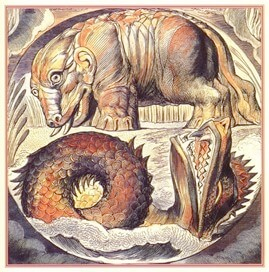
It is this crisis of the idea of progress that we can feel all over Ernst Jünger’s oeuvre, from his famous diaries of his experience in the Great War (In Stahlgewittern), to his “prophetic” work Der Arbeiter and his late novels. But one book of his in particular allows us to penetrate in the nihilistic zeitgeist of the inter-war period: his Auf den Marmorklippen, published at the zenith of Hitler’s power, in 1939. This little book – On the Marble Cliffs, in English –, forgotten in the same way which its author is neglected by the intelligentsia, tells us more about our own times – which are also times of crisis – than several of the “scientific” works that are widespread today, and which denounce a supposedly evident return of fascism. In this jüngerian tale, the despotic figure of the tyrant appears in its most violent essence, as the result of a cosmological disorder that hits society in all of its foundations. On the Marble Cliffs is a book that needs to be remembered, the meaning of which seems today almost as intelligible – and appropriate – as when it was first published.
We aspire to an objective, practical understanding of Ernst Jünger's life and works, and encourage other seekers of freedom and self-realisation to join us. Jünger's insights can function as a valuable roadmap to freedom and meaning for individuals in today's social and spiritual landscape. Crucial is his figure of the autonomous and inwardly-free anarch (in contrast to the impotent and self-destructive anarchist) as presented in his important novel EUMESWIL.
Showing posts with label nature. Show all posts
February 17, 2021
Between Order and Disorder: Ernst Jünger on the Marble Cliffs - by Francisco Carmo Garcia
(From VoegelinView, 16 Feb 2021)
October 11, 2013
Exhibition: Ernst Jünger and Albert Renger-Patzsch
Just received notice of this interesting exhibition in Boulder, Colorado, from its curator, Ross Etherton, a PhD student at the University of Colorado Boulder.
His exhibit showcases many early copies of Jünger's works, most of which once belonged to Gerhard Loose (one of Jünger's biographers), as well as some hand-labeled beetles that belonged to Jünger (on loan from Dr. Frank Krell from the Denver Museum of Nature and Science, who met Jünger in the 1980s). The exhibit also features early copies of Renger-Patzsch's books, as well as Bäume und Gestein.
Although already open to the public, the official opening ceremony is on Monday Oct 14.
(Reminds me that there was another Jünger and Renger-Patzsch exhibition in Munich last year....)
April 10, 2012
Der kosmische Ernst Jünger
Hier ein Text über "Auf der Marmorklippen" - ich finde ihn sehr lesenswert, auch für seine Betrachtungen über unsere eigenen Lage. Und ich bedanke mich für den Hinweis bei dem Verfasser, Philippe Guichard....
Der kosmische Ernst Jünger.
In "Auf den Marmorklippen" erinnert die Prosa von Ernst Jünger an die "Illuminationen" des Arthur Rimbaud. Es sind Sätze eines "Sehers", die eine wohl geordnete Traumlandschaft schöpfen. Das Buch stammt aus dem Jahr 1939. Die Tagebücher zwischen 1941 bis 1945 veröffentlichte Jünger unter dem Titel "Strahlungen", ein technisches Wort, das sein kosmisches Wesen aufs Schärfste trifft.
"Auf den Marmorklippen" beschreibt eine Idylle, die Zeiten an der "großen Marina", einer Weingegend, in der die Seele im Herbst die Frucht der Körperarbeit erntet: "wenn in den kleinen Städten und Dörfern die Torkel zu knarren begannen und der Geruch der frischen Trester um die Höfe seine gärenden Schleier zog, stiegen wir zu den Wirten, den Küfern und Weinbauern hinab und tranken mit ihnen aus dem bauchigen Krug." Im Frühling findet sich die Harmonie auf dem Marktplatz im Fackelschein beim Maskenaufzug wieder: "die Männer gingen als Vögel und die Frauen waren in Prachtgewänder vergangener Jahrhunderte vermummt. Sie riefen uns mit hoher, verstellter Spieluhrstimme Scherzworte zu, und wir erwiderten mit schrillem Vogelschrei."
December 4, 2011
The Tree - an unofficial translation for the Munich exhibition
For any non-Germans visiting the Munich photographic exhibition "Über Bäume und Gestein. Albert Renger-Patzsche und Ernst Jünger", here is an unofficial translation I found of "Der Baum".
"Every language contains a wealth of words that constitute its being. Poetry lives by them. As if a bell had been rung, they awaken an aura of echoes in us. “Tree” is one of these words.
The Tree is one of life’s great symbols, perhaps its greatest. And thus it has been admired, honored and also worshipped through the ages by men and by peoples. Its height and breadth, its many centuries of age, and its majestic, protective stature seemed worthy of veneration.
November 26, 2011
"November" - a Jünger translation for the season
When I met Ernst Jünger in 1995 in the company of the Association Eumeswil Florence and asked about any particular works he desired to be translated into English, he produced a compilation of essays entitled "Grenzgänge" (Border Crossings). Here is one essay I have just finished in unofficial translation - just in time for this grey month of darkness and dying, and already dreaming of spring renewal!
"With each fall, the angel of melancholy comes. We should sacrifice to him, not flee from him. This is one way of celebrating the mystery of death: dying too must be practiced. The fruit ripens and is harvested; the leaves change color and fall. Crows gather in flocks and circle over the bare fields. The days become shorter, night falls earlier; fire and light are discovered anew. The time approaches for the festivals of the dead and walks in the cemetery, but also for nightly visits of charitable deities. Our dreams start to transform; mantic traits slip in. We near the most secret time of the year, the bleak nights and the festivals of light. The light is safeguarded; it becomes the light of the cave, hidden auspicious light.
In the gardens, the first frost has ruined the flowers: the nasturtiums, dahlias, asters, morning glories, the last lilies and the colorful sweet peas on the fence. Only the chrysanthemums, filled and unfilled, continue blooming in many colors, also late roses, often right into December. Our steps rustle in the yellow foliage of the hazel bushes, in the coppery leaves of beeches and the deep red ones of wild grapes.
Subscribe to:
Posts (Atom)


