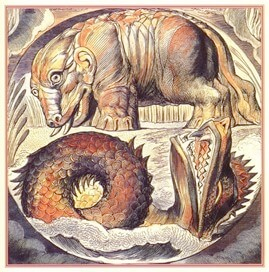
It is this crisis of the idea of progress that we can feel all over Ernst Jünger’s oeuvre, from his famous diaries of his experience in the Great War (In Stahlgewittern), to his “prophetic” work Der Arbeiter and his late novels. But one book of his in particular allows us to penetrate in the nihilistic zeitgeist of the inter-war period: his Auf den Marmorklippen, published at the zenith of Hitler’s power, in 1939. This little book – On the Marble Cliffs, in English –, forgotten in the same way which its author is neglected by the intelligentsia, tells us more about our own times – which are also times of crisis – than several of the “scientific” works that are widespread today, and which denounce a supposedly evident return of fascism. In this jüngerian tale, the despotic figure of the tyrant appears in its most violent essence, as the result of a cosmological disorder that hits society in all of its foundations. On the Marble Cliffs is a book that needs to be remembered, the meaning of which seems today almost as intelligible – and appropriate – as when it was first published.
We aspire to an objective, practical understanding of Ernst Jünger's life and works, and encourage other seekers of freedom and self-realisation to join us. Jünger's insights can function as a valuable roadmap to freedom and meaning for individuals in today's social and spiritual landscape. Crucial is his figure of the autonomous and inwardly-free anarch (in contrast to the impotent and self-destructive anarchist) as presented in his important novel EUMESWIL.
Showing posts with label evil. Show all posts
February 17, 2021
Between Order and Disorder: Ernst Jünger on the Marble Cliffs - by Francisco Carmo Garcia
(From VoegelinView, 16 Feb 2021)
October 21, 2009
Cain, Tubalcain and the Anarch
China's 60th Anniversary national day
What would an anarch have to say to the above spectacle? Here's what the Ur-Anarch Ernst Jünger wrote in "Glass Bees":
When new models were displayed to the masses at the great parades in the Red Square or elsewhere, the crowds stood in reverent silence and then broke into jubilant shouts of triumph. What was the meaning of this thunderous roar, when on the ground turtles of steel and serpents of iron rolled past, when in the sky triangles, arrows, and rockets shaped like fish, arranged themselves with lightening rapidity into ever-changing formations? Though the display was continual, in this silence and these shouts something evil, old as time, manifested itself in man, who is an outsmarter and setter of traps. Invisible, Cain and Tubulcain marched past in the parade of phantoms.
Subscribe to:
Posts (Atom)
